Showing posts with label Leadership and Management. Show all posts

Tuesday, April 8, 2014

The Madness Isn't Over Yet!


We have come to the end of the time period US sports fans refer to as "March Madness" - 68 collegiate basketball teams have competed in a single elimination tournament - and UConn has been crowned "national champion".

In the past we have used this event as a reason to perform a statistical project (see Who WIll Be in the Final Four - Lessons From an Analytical Journey).

This year we'll do things a little different.

Be Strong!

George Gallup founded the firm that bears his name in the 1930's. Their initial claim to fame was public opinion polling. Results of their inquiries were often cited in news media (tv, radio, print, etc.), especially around election season. They have to be one of the original data analytics firms.

At the turn of this century a group of Gallup consultants authored a pair of best-seller books - First, Break All the Rules and Now, Discover Your Strengths - based on Gallup insights developed over the years from their work with companies and industries.

One of the main themes coming out of this research was, as this Forbes article states, a "ceaseless belief that people should focus on making the most of their talents, rather than struggling to mend their flaws".

One of the ways this was described in the books was that the neurons in our brains form millions of connections with each other, which we can think of like a transportation network. Some connections, reinforced through time, are like super-highways, while others, rarely used, are like back country dirt roads.

The super-highways become strengths, while the others do not.

Ultimately, Gallup distilled the number of these strengths to a total of 34 (you can see a listing of these at this Wikipedia entry).

Are Some Strengths Better Than Others?

The question that has always come up for me is that while all the strengths are positive, for the finance practitioner it would make sense that some are better than others.

Put in a slightly different way, if we were given a listing of 20 people, and the only information we had about these folks was their top 5 strengths, who should be the one that we would hire?

So to have some fun with NCAA "bracketology" while seeking to achieve insight into the issues above, this year we will focus on the Strangthsfinders tournament!

Setting Up The Tournament

Unfortunately, 34 strengths do not fit neatly into a bracket structure, since in each round we need a number of teams that is a square of 2 (1,2,4,8,16,32 etc).

In order to achieve this, we have a 'play-in' round, where 4 of the strengths compete for 2 spots. Once this round is complete we will have a field of 32, which can then be arrayed in the normal bracket structure.

The 34 strengths were taken and randomly assigned to two groups: A or B. In each of these groups, a further random assignment of 'seeds' was performed, from 1 to 17. In the NCAA structure, a 1 plays a 16 in the first round, a 2 plays a 15, and so on.

The play-in games were between the strengths identified as the 16th and 17th seeds.

For the play-in games, I solicited votes within my Twitter and Linked In communities, randomly selecting individuals to answer the question: "Which of the following strengths is it more important for a Finance Person to possess?".

Play-In Teams

The first play-in is between:

Activator - one who acts to start things in motion. People strong in the Activator theme can make things happen by turning thoughts into action. They are often impatient

Analytical - one who requires data and/or proof to make sense of their circumstances. People strong in the Analytical theme search for reasons and causes. They have the ability to think about all the factors that might affect a situation

And the second play-in is between:

Empathy - one who is especially in tune with the emotions of others. People strong in the Empathy theme can sense the feelings of others people by imagining themselves in others’ lives or others’ situations.

Responsibility - one who, inexplicably, must follow through on commitments. People strong in the Responsibility theme take psychological ownership of what they say they will do. They are committed to stable values such as honesty and loyalty.

Results

Figure A
Play-In Game Results

Figure A shows that both of these games were blow-outs, with Responsibility and Analytical sprinting easily to the win.

Given the number of job roles the finance profession has with the word analyst in it - financial analyst, budget analyst, business analyst, cost analyst, etc. - it only makes sense that this strength would prevail over Activator, which seems suited to business entrepreneuers.

Yet, as @fundingprofiles, one of the survey respondents, noted "Activators are rare in finance. Analytical minds are too, but not as rare", suggesting that while the talent is valuable not many actually have it!

Perhaps those job titles are simply a matter of wishful thinking?

In the second matchup, Responsibility came out well ahead of Empathy. As a fan of Design Thinking (see Should CFO's Be Design Thinkers), this was a disappointing result since Empathy plays a major role in that process.

Yet, given that Responsibility involves "following through on commitments" and "honesty", these are valuable when the books need to get closed and accurate numbers need to get reported, so we can see that while it might be nice to have a Design Thinking mindset, the ongoing day-in, day-out requirements of the finance role make the one strength more valuable than the other.

As one anonymous respondent stated "Both are good but Empathy without Responsibility would not work". Amen to that brother or sister!

The Bracket

With the play-ins complete, the Finance Strengths bracket now looks like that shown in Figure B. There are lots of potential items to discuss as we move through the "games", so stay tuned, either by adding this blog to your reader, following me on Twitter, Linked In or Google + (buttons for all those are located along the right side of this blog).

Figure B
Finance Strengths Brackets

What You Can Do

Vote in one of the next round matchups!

Having first hand knowledge of the abuse of half hour long surveys, I designed each of the following to take less than a minute of your time - each one has only two match-ups. You don't have to do them all, but completing one would certainly help out for the next round.

Thank you in advance for participating!


These are half of the first round games. Others to come once these results are in!

Key Takeaways

Finance people need to have Analytic strengths and a strong sense of Responsibility.

You May Also Like
Questions
    ::Do you agree that Empathy without Responsibility would not work for a finance role?
    ::Are Analytic strengths rare in those who hold finance positions? Can you share a story about this?

Add to the discussion with your thoughts, comments, questions and feedback! Please share Treasury Café with others. Thank you!


Wednesday, August 21, 2013

Does Your CFO Got What It Takes?

As a frequent blog reader I often run across articles with some form of title such as "7 Secrets of ....." or "10 Tips For ..." and my reaction is always "How do we know there are only 7 secrets?" or "Are there really just 10 tips someone can use?"

Sometimes these figures can represent nothing more than the number of things the author was able to come up with as they were writing their article!

In order to get past these limitations, I like to employ a technique I call triangulation (not to be confused with land surveys).

Triangulation is a process we have used in prior posts (Triangulating Mission and Vision Using Mind Maps and Triangulating Steve Jobs for example). The method consists of two steps:

  1. gather together a number of different sources of information about a topic we are concerned about, and
  2. for each source, identify areas of similarity and difference with the others

Figure A
The Triangulation Process
The star represents areas of universal commonality among all five circles

We can picture this process with the Venn diagram shown in Figure A. Each circle represents one perspective on the topic, such as Author A's "7 Secrets" or Author B's "10 Tips". Researching a topic in this manner creates two useful classes of information.

First, we are able to identify elements that have a universal commonality. The star in Figure A shows the area where all agree - i.e. one of Author A's "Secrets" is also one of Author B's "Tips".

Second, we are able to expand the size and scope of our information base. Keeping the math simple, if each of 5 authors has 10 "Secrets" or "Tips", and 5 are common to all the authors and none of the others overlap, then we end up with 55 "Secrets" or "Tips" rather than 10!

The benefit to the first approach is that we get to focus on the most important elements. After all, the items that most or all experts agree are important probably are important, and by identifying what these items are we can focus on them and not get led down blind alleys. In essence we are making use of the 20/80 rule as we consider the issue.

The advantage to the second approach is that we get a more complete representation of the topic - i.e. we have gotten closer to learning all the "Secrets" or "Tips". This larger universe gives us a wider range of potential actions or ideas to pursue, and reduces the chance that we are going to overlook something important.

It Suddenly Occurred To Me...

One technique used to generate innovation ideas is to "split" a concept or problem into two different attributes, then split each of those into two, then each of those into two, and so on until we have a number of pieces that we can rearrange like a puzzle (note - I originally learned this technique from the book "Thinkertoys").

I was practicing this technique recently using the term "CFO". The three initial split possibilities I identified during this exercise were:

    ::Activities and Characteristics
    ::Small Business and Large Business
    ::Public Company and Private Company

In reviewing this list, I recalled that we addressed the "activities" dimension of the first split in the list above last Fall in a post entitled Triangulating the CFO Mission Using Mind Maps but that we have not done much analysis of the "characteristics" path up to this time.

So let's check it out!

Who Cares About the CFO's Characteristics?

The first step in our triangulation process is to identify a number of sources to review. A logical group from which to choose would be the "customers" of the CFO.

One of my favorite representations of the CFO's stakeholders is the CFO Relationship Map by Samuel Dergel, reproduced here in Figure B. In this map he identifies four main vectors of relationship:

    ::Vertical Up - stakeholders the CFO reports to, such as the CEO, Board of Directors, and Investors
    ::Vertical Down - those that report to the CFO
    ::Horizontal External - those outside the organization whom the CFO deals with on a more or less equal footing
    ::Horizontal Internal - those within the organization that are peers, such as other C-level executives

Figure B
Samuel Dergel's CFO Relationship Map
The combination of these four groups constitute the bulk of the CFO's primary relationships and are the main beneficiaries (or victims!) of their characteristics.

Stakeholders Who Pay The Bills

The "Vertical Up" groups - board, investors and CEO - are arguably the most important portion of the relationship map, if for no other reason than it is these folks who sign the CFO's paycheck. If they're not happy, extremely positive relationships in the other three relationship sectors are not likely to matter much.

The most in-depth relationship within this group is the CEO. In "CFOs: Characteristics and Qualities of Top Performers", survey results revealed that half of the CFOs spent 3 hours or more per week with the CEO in 1:1 settings. The study notes that:

"The hallmark characteristic for this relationship is candor, with nearly all of the Top CFOs reporting a strong ability to be direct and candid in communicating with the CEO."

Frank interpersonal exchange is a quality echoed by Kevin Rakin (former CFO, longtime CEO, member of several boards, private investor), who states in CFO Magazine's What Entrepreneurs, VCs Think About CFOs:

"You want a CFO and a CEO who [will] be able to call each other on a Sunday night, talk honestly and hash something through. Investors pick up on that. When you go out on a roadshow they can see whether these guys are a team or are going to have ego fights over whatever’s going on"

James Robinson, co-founder and managing partner of venture-capital firm RRE Ventures, in the same article calls this characteristic "a personality fit with a particular company and its CEO".

Ken Marshall, serial entrepreneuer and current CorrelSense CEO, notes in the CFO Magazine article that the "CFO needs to provide a reality check when the CEO gets into that [driving too fast due to obstacle blindness] mode". In order for this to occur productively, the CFO must engender both trust and respect in their CEO relationship.

Investors also consider the CEO-CFO relationship to be important. The g.a. kraut company published a whitepaper consisting of 11 interviews with investment professionals entitled "What Makes a Great CFO?". One of the professionals interviewed in this article said:

"... it's more than just having a handle on the numbers. In fact, that's the minimum requirement. If the CFO can add value on the operating side or the strategic side, that's when you see the CEO and CFO are running the company together."

While another said:

"It’s very important that the Street understand the relationship between the two because it’s an important piece of the Street having confidence in the CFO.

Figure C shows the tag cloud (produced using Tag Crowd website) for the "What Makes a Great CFO?" article.

Figure C
The five most prevalent words in this figure are Understand, Business, Company, Investors and People.

Reconfiguring these into a sentence, we might say that the "great" CFO's "Help People (including Investors) Understand the Business and the Company".

The "Help People Understand the Business" and "Partner with the CEO" themes apply to board relations as well. In a blog post from North Carolina State's Poole College of Management's Enterprise Risk Management Initiative entitled "The CFOs Relationship with the Audit Committee for Effective Risk Management", the authors state:

"Audit committees are especially committed to oversight on behalf of shareholders and they expect CFOs to do the same. CFOs that follow CEO-level thinking, in thoroughly understanding the business, have a more powerful impact. The primary objective of a business is to drive intrinsic value- this requires a complete understanding of the company’s environment and the industry’s competitive atmosphere."

The Experts

The "Horizontal External" groups represent professionals outside the firm with whom which the CFO interacts. These include auditors, lawyers, banks and other major service providers.

This is a broad group, which makes it difficult to generalize. For example, auditors are privvy to all the information the firm produces, whereas many bankers will only be told information that is 'publicly available'.

Arthur F. Rothberg, the Managing Director of CFO Edge (a provider of interim CFO services), in his "Audit Preparation: A Formula for High Return on Audit Investment" whitepaper states "Successful audit preparation and audit completion are deeply grounded in the working relationship between the company and its audit partner", and that the company is the one that "sets the tone" in the relationship, primaily through its level of "honesty" and "integrity".

According to CFO Magazine, in "Auditor Angst", "ask auditors what keeps them awake at night and client-related issues will top their replies." These primary stresses can be generated all along the continuum, from unprepared audits on the one end to "difficult to work with" clients on the other.

Interestingly, the magazine noted that "the hassle from clients, in fact, far outranked other strains, such as the pressure to generate more revenue." At heart, basic relationship issues are at play, such as "consideration", "appreciation", "failing to seek input", "no surprises" and "taking the time to get us what we need".

Figure D
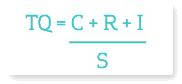
Charles H. Green's Trust Equation

TQ = Trust

C = Credibility

R = Reliability

I = Intimacy

S = Self-Orientation

The groups in the Horizontal External category are advisory - they are supplementing the CFO's core knowledge with deep insight and experience in particular professional niches. One useful depiction of the advisory relationship is Charles H. Green's Trust Equation, which is shown in Figure D.

The equation itself tells us something of what a CFO needs to do. If an advisor is trusted because they are creditible, then the CFO needs to be able to identify creditibility. If an advisor is trusted because of intimacy, then the CFO needs to be intimate.

In the Trust Equation, the level of "self-orientation" of the advisor has a significant impact. The other 3 terms can be overwhelmed if the advisor is "out for themself", while advisors can magnify their trust by maintaining an "other" orientation. The ability to discern between those with an underlying motive and those who are "true friends" is therefore critical in terms of selecting advisors who are truly trustworthy.

The Internal Organizational Environment

The "Horizontal-Internal" and "Vertical-Down" paths share the characteristic that both are part and parcel of the specific organizational context, and for this reason will exhibit similarities.

The internal organization of the firm creates significant relationship opportunities and challenges for the CFO. The size and composition of the "C-Suite" team will determine who the CFO's peers are and what "fiefdoms" they control. Each executive's organizational power and influence will be concentrated if the number of peers is small, while it will be diffused if the team is large.

A CFO must be his/her own worst critic if they are going to continuously grow, develop, and step up their performance. Korn/Ferry, one of the top executive "headhunter" firms, in their "Developing Your C-Suite" whitepaper, discusses the perils CFOs face without this trait:

"C-suite executives often see themselves—rightly so—as among the select few, the special club of those who have reached the top, the best and the brightest. Moreover, family, friends, associates, employees, and the media treat them as though they are the most gifted and accomplished people in their field—the stars of the show, so to speak. This is heady stuff, and it can propel executives into a delusional “fun house” where their self-image is distorted by the success they have attained. If executives believe all the hype about themselves, they can fall prey to two disabling mindsets — the myths of attainment and infallibility."

Others have called this "living in the bubble" (my apologies for not remembering the source).

The "myth of attainment" Korn/Ferry mentions refers to the following mindset:

"Many C-suite executives conclude — consciously or unconsciously — that when they reach this pantheon of business they have “arrived,” and, having reached the top, have nothing more to learn."

While the "myth of infallibility" refers to:

"People who have been successful and made good decisions throughout much of their professional lives can come to believe that they are infallible, and their status as C-suite executives can amplify this effect. Moreover, others in the company often treat them as though they are infallible, which may be more a tribute to their power than a recognition of actual superiority."

Four abilities are helpful in innoculating the CFO from falling prey to these myths:

    ::Contrarian Mindset - the ability to go against the prevailing trend
    ::Social Independence - turning a deaf ear to the expectations and feedback one is receiving from many in the community
    ::Strong Desire to Personally Improve - using internal motivation to determine goals, actions, and priorities
    ::Introspective Capability - the ability to question and examine one's own thoughts and behaviors without prejudice

In addition to the above, Korn/Ferry discuss a more general aspect of the organizational environment they dub the "Captain of the Ship" syndrome:

"...executives live life in a fishbowl. People are watching them constantly and closely, looking for signs of encouragement or danger. After all, when the leader is glum, it may foreshadow doom for everyone else. Conversely, when the leader is relaxed, confident, and happy, it signals good times ahead... "

This implies that:

"Consequently, even if captains of ships or C-suite executives have doubts and uncertainties, even if they know they need help, even if they want more development, they are often reluctant to reveal weaknesses because doing so could sow the seeds of doubt, and with doubt come defections (who wants to remain on a sinking ship?), loss of confidence, and anxieties that get in the way of the real work to be done..."

Finally concluding that:

"The C-suite can be a paralyzing environment for executives who prefer openness and candor."

It is interesting to note that Korn/Ferry brings us to the opposite conclusion we explored earlier in the "Stakeholders Who Pay the Bills" section - which was all about frank conversations, opinions, and "telling it like it is".

Executive Presence

Lest we forget, the CFO is also an entity in Dergel's diagram, and perhaps it is the most important one.

We have so far identified a listing of traits required of the CFO from different perspectives. A number of these may "roll-up" under the heading of "Executive Presence", which is a term used to describe the sense we have that a person is capable of work at that level.

Suzanne Bates, CEO of her own communications firm for the past 13 years, in her blog post The 7 Elements of Executive Presence, identifies seven (surprise!) factors that comprise Executive Presence:

    ::Substance - demonstrating command of subject matter and "sharing that expertise in a powerful way". She notes that "if you cannot convey your business and technical skill, you won’t get the recognition you deserve".
    ::Personal Style - the way we dress and conduct ourselves. Bates notes that "Your business attire should make you feel confident and powerful every single day"
    ::Physical Presence - how you project yourself physically, both in action and attitude. Bates says "Learn to sit, stand, walk, move and gesture purposefully - it says so much about your professionalism"
    ::Vocal Skill - monotone speakers do not demonstrate executive presence. Suzanne tells us "your voice should be conversational and clear, and it should demonstrate your confidence, enthusiasm, passion and intelligence"
    ::Manners/Etiquette - showing concern for others comfort, being "gracious", and demonstrating an awareness of the protocols in various situations
    ::Receptivity/Listening - Ms. Bates explains "Listening includes being accessible, encouraging people to express themselves, listening with mindfulness, not speaking too much, and using verbal and non verbal language to convey genuine interest in the other person"
    ::Workspace - the workspace is an "extension of you", and as such it communicates to others messages that can be as powerful as if it came from us directly. Bates notes that our offices "can be a tip off to others about how you really conduct business"

Note that aside from the first item on the list, none of these characteristics have to do with technical expertise as opposed to personal qualities.

Paul Aldo, former professor turned management consultant turned leader developer, in So What is Executive Presence Again? identifies nine "dimensions" that comprise Executive Presence, broken down into three categories:

"Personal Dimensions

    ::Passion - the expression of motivation,drive, and engagement that convences others you are committed to what you are saying and doing.
    ::Poise - a look of sophistication and unflappability that creates the impression you are comfortable in your surroundings and able to handle adversity.
    ::Self-Confidence - the air of optimism and assurance that convinces others you have the required strength, resources, and resolve ti initiate and lead.

Communication Dimensions

    ::Candor - the appearance of being interested in truth and honesty, with a willingness to accept and engage the world as it is, not as you would like it to be.
    ::Clarity - the ability to create your story and tell it in an intuitively clear and compelling way.
    ::Openness - the willingness to consider other points of view without prejudging them.

Relational Dimensions

    ::Thoughtfulness - the projection of thoughtfulness when dealing with others that conveys an interest in them and the relationship.
    ::Sincerity - the conviction of believng in and meaning what you say.
    ::Warmth - the appearance of being accessible to others, physically and emotionally."

D.A. Benton, in her book "Executive Charisma", identifies 6 factors involved:

    ::"Be the First to Initiate"
    ::"Expect and Give Acceptance"
    ::"Ask Questions and Ask Favors"
    ::"Stand Tall, Straight, and Smile"
    ::"Be Human, Humerous and Hands On"
    ::"Slow Down, Shut Up, and Listen"


CFO’s need to make a great first impression for a number of these characteristics on the non-verbal level as well. Carol Kinsey Goman, body language expert, tells us in her Forbes article that:

“Research shows that we make eleven crucial decisions about one another – subconsciously evaluating an array of nonverbal cues – within the first seven seconds. And once someone labels you as “likeable” or “un-likeable,” “powerful” or “submissive,” everything else you do will be viewed through that filter”

In addition, Goman lets us know that there are two particular sets of traits are important for CFO’s to communicate non-verbally:

“There are two sets of nonverbal signals that people look for in leaders — status & authority and warmth & empathy — and the most effective leaders employ the right signals at the right time. Which means they realize that the body language signals that work so well when announcing a new business strategy are not helpful (and in fact may sabotage their efforts) when building collaborative teams.”

Conclusions

Recurring themes (the star in our triangulation picture) throughout this post center primarily on relationships and communication. Whether it is the CEO, investors, knowledge experts, service providers, or organizational teammates, making the most of these relationships is essential to CFO success.

Strong communication skills are also required in all the settings. The CFO needs to help investors understand the business while simultaneously convincing them that they are competent to be in the role. Communication with service providers creates a positive working relationship that allows the CFO to utilize these experts productively. Those within the organization need to see the leader's strength, confidence, and conviction.

Within these broad characteristics, the CFO must be versatile in balancing the tactical aspects of relationships and communication, since managing the different groups requires somewhat different styles of interaction. The relationship style with the CEO needs to be open and candid, while with others in the organization the CFO must practice more impression management. With outside experts, the CFO needs to be intimiate enough with their advisors to be able to benefit from their expertise. In all these circumstances, however, it appears they must exude Executive presence, the combination of signals to others that they are a person of status, authority, and expertise.

Note: There is a large body of knowledge about CFOs and what characteristics are considered important. This post will be updated periodically as I run across other items that will contribute to our triangulation approach to the topic.

You May Also Like
Questions
    ::What are the most important CFO qualities from your perspective?
    ::What experiences have you had with CFOs who did not exhibit strong relationship and communication skills?

Add to the discussion with your thoughts, comments, questions and feedback! Please share Treasury Café with others. Thank you!

Tuesday, July 30, 2013

The Best 5 Minutes in Line I Ever Spent

I am in the grocery store the other day, standing in the checkout line.

This is not news, nor is it very surprising. We need food from time to time, be it for survivial, or because a large stampede of in-laws are on their way over, or because my wife has run across a great new recipe we want to try.

Nothing in and of itself worthy of a blog post. For sure.

It was still early in the day, so the store was almost empty. Most people in town were probably still reading their Sunday papers or catching up on a few, much needed, extra hours of sleep.

So why, on this particular occasion, did my wait in the checkout line become a little longer than expected?

And why am I writing about it?

The Person In Front of the Line

The only person ahead of me in the checkout line was an elderly lady. She made mention to the cashier that she did not find a particular brand of barbecue sauce (brand "X" for the sake of this post). She especially wanted this item because she had a coupon!

"Oh, it's on the right-hand side just down there on aisle 5" the cashier told her (Note: having bought barbecue sauce at this store before, I knew she was right about this).

The lady looked somewhat distraught. She wanted to go get it, but was concerned about causing the additional wait. "Do you mind?" she asked.

"Not at all" I replied. Even if I did mind, or was in a rush, Aisle 5 was right there behind us, I knew that X was right there, I was next in line, and it was an early weekend morning, in no immediate hurry for anything.

The lady customer eventually returned. I fully expected her to have a bottle of X in hand, ready to scan, but there was nothing. "It's not there" she stated.

At this point the cashier took matters into her own hands. She left the register with a pleasant comment and proceeded to make her way down aisle 5.

And 30 seconds later back she came with a big 'ole bottle of X barbecue sauce. "Here it is" she said sweetly.

In my mind I commended her, and admired her skill in handling the situation. She did not blame. She did not accuse. She made it seem like the most normal of things that people cannot locate X in aisle 5.

And our elderly customer's reaction confirmed it.

"Thank you" she said. But the thing was, it was a "thank you" without embarrassment, without shame, without a sense of foolishness for having missed it, or any other such thing. From this particular customer's perspective, it might never have came from aisle 5 at all, and the cashier did nothing to make it seem otherwise.

And then she was on her way.

But That's Not the End of the Story

At this point you might be saying "well that's a great example of customer service, with a nice bit of emotional intelligence rolled in" and be willing to go along your way.

I was.

Our cashier looked at me, a hint of 'I'm sorry about that but I'm sure you understand' in her eyes. She scanned my few items - one bag in total - and I was done and proceeded to head for the exit.

I thought it was great what she did that for the customer. I had no problem with it at all. What's 5 minutes on a lazy Sunday morning? I was happy the lady left happy and got to use her coupon (if you ever experienced my wife's wrath for forgetting to use them you'd understand that feeling!).

And then there...

...right before the exit door...

...posted on the bulletin board...

...for all to see...

...was an 8x11 sheet of paper with a selection of each of the store's cashier's statistics for the past week printed on it: seconds per each item scanned, downtime between customers, and rank within the region.

Is What's Measured Important?

Let's think about the implications of this for a minute.

Our cashier is clearly working in an environment where management has focused in on efficiency. Scan those items fast and once you are done with one customer start on another...right away!

In fact, this is so important, and we are so serious about this, we are going to call you out to the world to let them know where you stand in the world of cashier efficiency!

What were her options for dealing with our nice customer who could not find X?

    ::Option A: invite the customer to go back down Aisle 5 to find Barbecue Sauce X
    ::Option B: mumble something along the lines of "I'm sorry you did not find anything", all the while scanning any remaining items

And then going down the option A path, there are two additional alternatives to consider:

    ::Option C: walk down to Aisle 5 and get X for the customer
    ::Option D: mumble something along the lines of "I'm sorry we were out", all the while scanning any remaining items

Figure A
Cashier Option Diagram and Metric Payoff

These paths are diagrammed in Figure A, with the relative impact on the cashier's metrics noted on the right.

While metrics may have been important to the management, they obviously did not influence our cashier in this situation. At each point on the tree, she chose the option that made the metric worse, ultimately resulting in the worst possible metric achieved!

All The World Is A Stage

At this point in the tale we are happy that our cashier is a rebel. She has deliberately refused to be cowed or influenced by the metrics and has flaunted those measures in the sake of something we would consider noble and good: customer service.

She may not have walked a mile, but she certainly went the extra 50 meters (25 each way) up and back on Aisle 5!

One of the problems with using metrics is that they do not represent the whole of the situation. They are incomplete.

Using metrics to manage is akin to driving a car using nothing but the insturement panel. It's all fine and good to have a target speed of 60 miles per hour (or about 100 kilometers per hour), but if you are in rush hour and the car in front of you is stepping on the brakes you'd better be watching the road rather than your instrument panel!

Figure B
The Empty Stage

Figure B depicts a rough drawing of a stage, much like the one my family and I saw when attending a local community theater production of "Tom Sawyer" a few weeks back.

The problem with the stage in Figure B is that it does not provide any cues to the audience. There's just a big 'ole rectangle.

The dynamism of the stage is captured through the movement of the characters, the props, and the lighting.

Figure C
The Metrics Stage

Metrics work like the stage lighting shown in the 10-second video clip in Figure C. We focus on the point where the lighting occurs. If this is the point of action on the stage it is great. However,the "rest of the picture" has receded into the background and is never emphasized.

We are no longer attentive to it.

Should Figure C's lighting continue for the whole length of the show, (in addition to being very boring) we would miss out on a lot of the action that is occuring on other parts of the stage.

Figure D
The Real Stage

In order to avoid this predicament, the lighting of the show is dynamic, moving around to highlight the action taking place wherever it is, more like the 10-second video in Figure D.

Our grocery store story can be imagined in this way. The spotlight first focuses cashier efficiency. The customer has a problem, and the next spotlight highlights their search down Aisle 5. It returns to our cashier in the form of the problem not being solved, and moves again down Aisle 5 and back again, finally centering on a postive experience for the customer leaving the store.

Very little of this is captured by our metrics, because by their very nature they are static and not dynamic!

Old School Management?

Most of us have heard the phrase "what gets measured gets done". A lot of management disciplines subscribe to this theory. Most of these probably belong in what Daniel Pink would call a Motivation 2.0 mindset.

The simple fact is that a lot of management processes still in use originated in a different time and place.

In order to meet the needs of the industrial revolution, we developed techniques that worked well on assembly lines and in other highly repetitive but focused situations. Worker A turns screw #1, Worker B bolts one piece to another, and so on.

Our cashier does not work in this type of environment.

Yes, they scan items and complete transactions. But they also are problem identifers. The last three gallons of milk have been leaking, or customers in search of a certain brand of bread report that it is out.

They are also customer service providers, answering questions, greeting people politely, and making the occasional run down Aisle 5 to retrieve X.

They are wearing many hats in a dynamic environment, where the duties and objectives can change from second to second or minute to minute.

In our story the cashier shifted from efficient scanner to customer service representative. She had to exercise independent judgement, taking into account the context of the situation. Her performance cannot be scripted and precisely measured.

For instance, had it not been an early weekend morning with one customer in line, but a busy afternoon with six customers waiting and the prospect of more showing up in line real soon, she may have decided the cost of providing the personalized customer service of getting X from Aisle 5 to be too costly, and may have referred the customer to the service desk, or flagged down someone bagging groceries to do it, or called a manager.

Specific metrics in these types of settings are not very effective, because their range of focus does not account for the multiple, highly varying factors that are involved. The work environment is not so simple as it once was, and the methods for managing it that may have worked before no longer do.

The Curse of the Specialist?

Like our theater spotlight, one of the problems with functional areas is they focus on a narrower range of issues than the business as a whole, and are thus likely to miss important "pieces of the action".

Since finance folks like equations, evaluate the organization's performance through accounting measures, are more 'left-brained' than average, reside in offices and cubicles rather than 'the floor', and other reasons, the concept of coming up with metrics that can be consumed on their computer screens in the form of dashboards sounds like a great idea.

All the better if these metrics can be directly translated to financial performance.

From this perspective a focus on efficiency is ideal. With 100 customers and 5 cashiers, if we can be 20% more efficient we can get away with 4 instead, with an increase to net income as a result. Our company's performance is improving!

Yet, outside the spotlight, trouble brews. Poor customer service ultimately translates into fewer customers. Our finance team, plugging a change in customer throughput into their revenue side equations, may very well arrive at the conclusion that while short-term gain has occurred it has come at a long-term cost.

The Curse of the Easy?

Scan per item is a simple measure to calculate.

We have a cash register. It knows who the cashier is via log in. It counts how many items are scanned, and knows when the cashier logged in and logged out. All the data for the equation has been programmed in.

Conversely, there is no equipment to measure a customer's smile, or how many times the cashier went down Aisle 5. Implementing a system to track this, if it were possible, would likely be cumbersome or costly. Movement scanners or face recognition software connected to cameras require a capital investment. A logbook system creates additional demands on employee's time.

Unfortunately, this can create a situation where "we manage what we can measure", rather than what we really should measure.

The result is that our cashier is dinged in their performance reviews for the decline in their metrics, but is not correspondingly praised for their superior customer service performance.

As this continues to occur over time, they are going to be more likely to give up the unsung behavior, even though it is arguably more valuable.

What Can We Do?

Some might construe this post to be a case against metrics, which it is not.

So what am I advocating?

Take a Holistic View - metrics are one component of management, but they are only one component, for a number of good reasons we have just discussed. Factor them in, but remember that there is a lot of activity 'on the stage' that is not being captured but can be vitally important. Each function has its viewpoint, and we can avoid a lot of the specialization problems if we alternatively 'wear the hat' of all participants. When encountering a situation, ask yourself a series of questions rather than just the one your specialization would profess: what would finance do? marketing? production? operations? legal? sales? investors? community members?

Go to Gemba - the Japanese term Gemba loosely translated is "the place where it happens" or "where the activity is". One of the tactics used in Lean is to literally stand in one spot 'on the floor' and simply observe...for hours and hours. While this might seem boring, and perhaps sometimes it is, it is amazing to see the subtleties of the situation play out. A financial analyst engaging in this activity will see the unfolding of our cashier story, and will appreciate the significance of the cashier's customer service activity in addition to their efficiency metrics.

Trust in Your People - our cashier story ultimately is one of a triumph of basic humanity vs. an arbitrary system of rewards and punishment, and it forces us to consider alternative philosophies of management and people. In the behavior modification framework that the 'carrot and stick' system originates from, we are nothing more than pleasure seeking and pain avoiding creatures. Yet this does not explain our cashier's behavior in the least. What predominates in our story is one of human to human compassion, a desire to help, and a good deal of interactional common sense. Most will make the right call when given a chance - we don't need to reward them or beat them to accomplish it.

Key takeaway

Metrics are often a useful management tool but do not take the place of reasoned and balanced leadership judgement. The truly adept leader does not view all problems as a 'nail' should they be holding a hammer.

You May Also Be Interested In:
Questions
    ::What situations have you encountered where people performed in direct contrast to what their metrics would have incentivized?
    ::What practices would you recommend to avoid 'organizational myopia'?
    ::In what circumstances is 'what gets measured gets managed' an inappropriate framework to apply?

Add to the discussion with your thoughts, comments, questions and feedback! Please share Treasury Café with others. Thank you!
Friday, September 21, 2012

Don’t Waste Your Time Benchmarking Against Others

There are a number of different paths one can take to benchmark their finance and accounting organization’s operating performance against others:
·       Use publicly available information in order to calculate metrics, such as the Cash Conversion Cycle.
·       Use information from consulting firms who have a “window” into many firms’ performance and have consolidated and summarized this information.
·       Use a consultant to perform a study specific to your organization
·       Participate in a group study with a number of other firms, such as members of a trade association or industry group.
Avoid this activity if at all possible!
 
The Promise
The promise of benchmarking is that it will provide us with a nice, neat set of results that tells the operational tale. It is akin to looking at the sports standings – Team A is 16-3 and Team B is 13-6, and therefore Team A is #1.
The results are indisputable, and this simplicity provides comfort.
Running a business is a complex undertaking. As such, it is almost always the case that the decisions we face have the following qualities:
·       There is no clear answer among the alternatives
·       There is balance required amongst many factors, such as stakeholders interests or organization objectives
·       We lack all the relevant information
·       Feedback is not available or “muddy”
Decision making under uncertainty is stressful. We are never totally sure, and never will we ever be.
Benchmarking provides the illusion that there is feedback on these decisions, allowing us to say things like “We’re in the top quartile, so we must be doing something right” or “These three areas need to be the focus for our improvement efforts this coming year”.
The benchmarking results confirm and validate what we have done, and point the way for what we must do in the future. They are the lighthouse beacon in the stormy sea.
 
The Reality
The problem with this is that it does not reflect the reality of our organization or the environment we operate in.
Let’s look at some of the reasons:
 
Apples to Oranges
The results of a benchmarking study are never completely apples to apples, but rather apples to oranges.
There is a wide variety of options for where functions land within an organization. Risk Management, for example, may be housed in Accounting & Finance, in its own separate area with a Chief Risk Officer, or somewhere within the operating companies.
There are numerous “shades of gray” along the Centralization - Decentralization continuum. Benchmark Company A requires its operating units to come up with budget numbers that they then consolidate, for which purpose a number of people from across the unit devote a portion of their time towards budgeting work. Company B has a fully staffed unit within Accounting and Finance working full-time that comes up with the numbers after working with the business units.
If the benchmarking effort is very intensive, chewing up a lot of staff (or consultant’s) time and attention in order to “levelize” these differences, some of these factors can be overcome, but invariably some of them will be missed.
 
People are People
Decisions about how to go about the benchmarking itself involve a myriad of factors: the make up of the comparable group of companies, the methodology of the study, the metrics that will be used, who is selected to perform the study, and the scope of the analysis to be performed.
Because the benchmarking is initiated by human beings, underlying agendas will inevitably come into play with respect to these decisions.
For instance, what benchmarking results might you expect to see if the person initiating the analysis is going to use the results a) in order to enhance the status of the department within the organization in order to get a “seat at the table”, b) to burnish their resume for the recruiters who have recently been calling, or c) in advance of an upcoming critical performance review?
Compare that to the results you might expect to see if the person initiating the analysis is going to use the results a) to shake up an intractable bureaucracy inherited from a predecessor, or b) to paint a potential organizational rival in a bad light?
This is not to say that people are malicious or underhanded (at least for the most part). However, a lot of what we do is outside of our awareness and is in congruence with our needs and desires.
 
The Organization is Holistic
What do you think a parent’s response would be if you asked them “who is the better person, your first or second born child?” In all likelihood, we would expect the answer to be along the lines of “each one is special in their own way”.
The fact is that most organizational decisions will take into account a wide variety of perspectives and objectives.
Let’s say a benchmarking analysis comes back showing Company A with a cost per square foot of building space that is 25% lower than Company B’s. Before we conclude that Company A is the winner, let’s think about what might factor into that difference.
Company A, whose primary objective is to reduce cost, moved their headquarters to another jurisdiction to reduce taxes. Company B, who has long invested in community relations efforts, operates a booth at all the downtown street festivals, and has maintained their original presence in the community in which it was founded decades ago, has taken a jurisdictional move “off the table” when considering its options.
Or Company A has moved to a far-suburban “office campus” due to a new CEO’s preference, with the result that long commutes are now required for a large percentage of its workforce. Company B, on the other hand, conducted an employee transportation study and located their building near several transportation hubs in order to make it convenient for its workforce to get to work, thereby boosting morale and improving retention.  
Company leadership is required to balance the demands of a large number of stakeholders and the many varied needs of the business. There are literally hundreds of variables that can enter into the mix. Each decision embodies this balance amongst this multitude of competing objectives, and the amount of weight given to each will invariably be somewhat different between entities.
 
You Can Still Reap the Benefits
If benchmarking is not the answer, what is?
The “promise” of benchmarking against others is:
·         We will be able to identify who is world-class so that we can emulate them
·         We will identify areas of weakness that we can improve upon
These benefits are attainable without the time, effort and cost of conducting a study.
 
Become the Best
As discussed, the organization is holistic - it is not just the sum of its parts or described by one or two metrics.
Your vision should be to be the best Finance and Accounting unit your organization could ever hope to have. Spend the time you would have spent benchmarking performing the work of detailing exactly how “best” will manifest itself in your firm - do not rely on the simple platitudes of “providing the best service” etc.
View your organization as a separate business, and the CEO, the Board, the Operating Companies and other Staff Functions as your customers within this holistic structure. Find out what your customers want and need, and then go beyond and find a way to “delight them”. We have discussed fulfilling this type of vision in “Triangulating Mission and Vision Using Mind Maps” and “Rollin the DICEE”.
Avoid the temptation to identify other world class organizations, because if you are going to emulate another you have taken yourself out of the running for being the best. You might achieve being the same, but you will not be the best.
If we want to be truly world-class and best-in-breed, than the only appropriate benchmark to go after is the one we set ourselves! Internal comparisons will drive us farther and farther. Establishing targets and metrics that convey meaningful information about the path to our organization’s mission are valuable, and much more important than learning “who beats who” on facility cost per employee or some other silly measure! Looking to others conveys a loss of confidence in ourselves and keeps our sights set too low. Stay the course!
 
Continually Improve
Think about it this way – if we use an external benchmarking effort to identify the areas where we “are behind”, what happens after this occurs? The answer is - we will begin to devote time and effort towards improving those functions. We’ll have discussions, draft plans, and then go about executing them.
Well, why wait? We can implement the activities that would come out of a benchmarking study without ever needing to do the study itself. The two items – benchmark study and improvement efforts – are not “cause and effect”, but two separate and distinct activities. One does not beget the other, and either can exist on their own without the other. You do not need an external benchmark in order to improve.
But how can we identify the areas to improve? There are many methodologies that exist today to improve processes, such as Lean, Six Sigma, and BPM. Using any one of these will serve to guide us towards improvement efforts.
For example, in the Lean world they tell us to look for the “7 Wastes”. We can identify these today by:
·       Simply leaving our offices and observing people doing their work
·       Holding a departmental meeting where the current process is “mapped” and asking where the value added steps are and which steps do not add value
·       Asking the people doing the work what is inefficient and what creates “pain points”
·       Asking our customers what is working and what is not
The advantage to this is that we will generate process improvement opportunities today, not three months later when the study is completed. Let’s get going!
 
Key Takeaways
One cannot summarize an organization’s activity into a set of metrics anymore than one can drive a car simply by looking at the instrument panel. Don’t pretend that you can. And don’t get bogged down in comparing your organization to others. Focus on being the best provider of your organization’s needs, and improve constantly and continuously, and all the benefits of benchmarking are yours to enjoy without wasting your time.
 
Questions
·         What has been your experience with competitive benchmarking? Was it rewarding?
 
Add to the discussion with your thoughts, comments, questions and feedback! Please share Treasury Café with others. Thank you!